Scrypt ASIC Choices for an LTC Mining Pool
Two machines can both deliver 100 GH/s and differ by 30 kW at the wall. At 0.132626 LTC a day — $8.05 at $60.68 and 94,799,394 Scrypt difficulty — the revenue side is identical, but the energy line runs from $12.00 a day at 0.1 J/MH to $48.00 a day at 0.4 J/MH when power costs $0.05/kWh. Efficiency, not headline hashrate, is the specification that decides the outcome.

Key takeaways
- Compare in watts, not in GH/s: 100 GH/s of Scrypt hashrate consumes 10 kW at 0.1 J/MH, 20 kW at 0.2 J/MH and 40 kW at 0.4 J/MH.
- Revenue is fixed by the network: 0.00132626 LTC per GH/s per day at 94,799,394 difficulty, which is $8.05 a day for a 100 GH/s unit before power.
- Breakeven power price halves with every doubling of efficiency — about $0.0335/kWh at 0.1 J/MH against $0.0084/kWh at 0.4 J/MH.
- Pool settings move the smaller numbers: listed 4% versus 2% treatment of the block-reward component is worth about $4.83 a month at 100 GH/s, and the merged mining output is a separate asset.
What to compare before the price
Vendors lead with hashrate because it is the number that sounds like revenue. The specification that decides whether the machine survives a price or difficulty move is joules per megahash, because it fixes how much of the revenue line the electricity bill takes. Convert that figure into kilowatts for the size you are considering, then into kilowatt-hours per day, then into money at your own tariff — not at a national average that excludes transmission, demand charges and site losses.
Two other hardware details belong in the same comparison. The first is the power supply arrangement: a unit at 0.2 J/MH drawing 20 kW per 100 GH/s needs three-phase or high-amperage single-phase service and a distribution board sized for it, so a cheap machine can be an expensive electrical fit-out. The second is duty cycle realism. On Scrypt, a 25 GH/s board at 0.2 J/MH adds 5 kW, so a rack of identical boards multiplies the thermal load as quickly as the hashrate, and a site that cools for 10 kW will not cool for 40 kW without changes.
Power per unit, not hashrate per unit
The table below prices the same 100 GH/s of Scrypt hashrate at three efficiency classes, using the current revenue rate and a range of power tariffs. Every column is derived from the same two inputs: 0.00132626 LTC per GH/s per day, and the watts that efficiency implies per megahash.
| Efficiency | Power for 100 GH/s | kWh per day | Energy at $0.05/kWh | Energy at $0.08/kWh | Breakeven power price |
|---|---|---|---|---|---|
| 0.1 J/MH | 10 kW | 240 | $12.00 | $19.20 | About $0.0335/kWh |
| 0.2 J/MH | 20 kW | 480 | $24.00 | $38.40 | About $0.0168/kWh |
| 0.4 J/MH | 40 kW | 960 | $48.00 | $76.80 | About $0.0084/kWh |
Read the third column against the first and the buying rule appears: at $0.05/kWh only the 0.1 J/MH row leaves anything of the $8.05 revenue line, and at $0.08/kWh none of the three does on this hashrate alone. That is the arithmetic every Scrypt purchase has to survive, and it is why hosted sites and miners with curtailed or surplus power are the operators who can run older hardware.
The breakeven column is the most useful one to carry into a negotiation, because it is scale-free. At 0.2 J/MH the machine needs power under about $0.0168/kWh to stay ahead of its own consumption; at 0.1 J/MH that ceiling rises to roughly $0.0335/kWh. Nothing about fleet size changes it. One hundred machines need one hundred times the power and earn one hundred times the LTC, at the same breakeven.
Worked example
Take a single 100 GH/s unit and run the numbers end to end. Revenue rate: 0.00132626 LTC per GH/s per day multiplied by 100 GH/s is 0.132626 LTC a day. In dollars at $60.68 that is $8.05 gross; after the listed 4% fee on the PPS-settled block reward it is $7.73. Over 30 days the gross figure is 3.97878 LTC, about $241.43, and over six months it is 23.87266 LTC, roughly $1,448.59.
Now subtract the energy line. At 0.2 J/MH the unit draws 20 kW, or 480 kWh a day, which costs $24.00 at $0.05/kWh and $38.40 at $0.08/kWh. The gross revenue of $8.05 a day does not cover either figure, so on this reading the machine's own efficiency is the binding constraint, not the pool's fee. At 0.1 J/MH the energy line halves to $12.00 a day and gets closer; at 0.05 J/MH, 240 kWh becomes 120 kWh and $6.00, which is the first row where the revenue line leads at a $0.05 tariff.
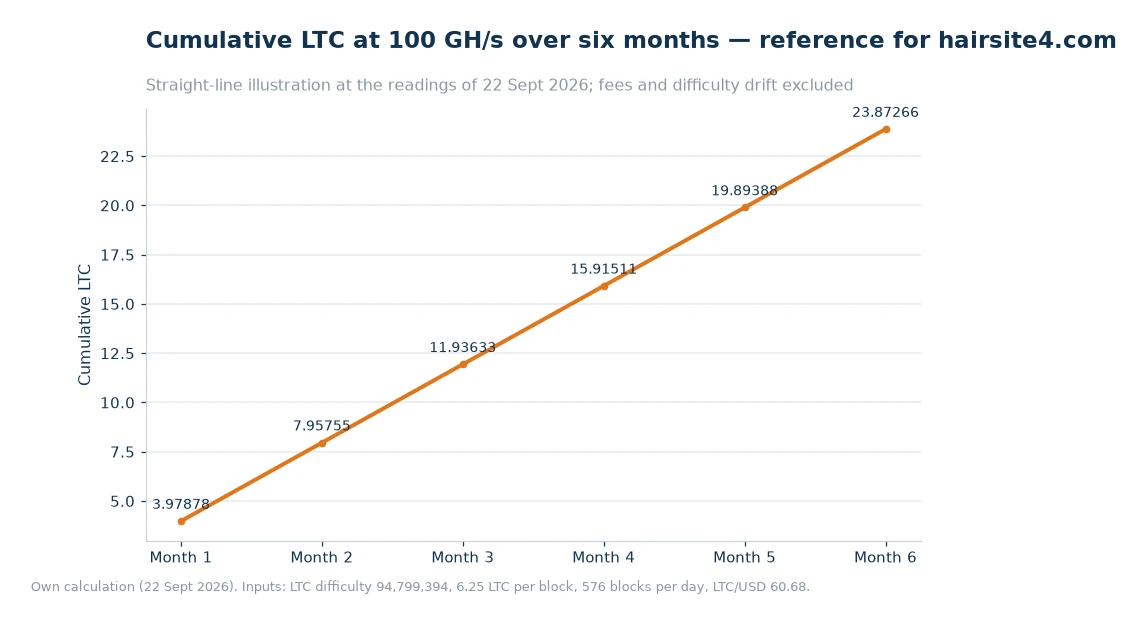
The chart is the revenue ceiling for the unit, and it does not include power. Month one is 3.97878 LTC, month six is 23.87266 LTC, and every kWh the machine burns comes out of that line before anything reaches the operator's pocket. It is also a ceiling in the other direction: Scrypt difficulty at 94,799,394 is not a constant, and a fleet bought against today's rate has to survive the next few increases.
Where pool settings fit
Pool selection cannot rescue a bad efficiency figure, but it does move two lines. The first is the fee treatment: PPS+ carries a listed 4% on the PPS-settled block reward with hourly settlement, and PPLNS carries a listed 2% on both components with payment after 6 confirmations across the last 5 difficulty rounds. At 100 GH/s the gap between the two treatments of the block-reward component is worth about $4.83 a month at constant difficulty and price — small next to the energy line, but it is money that does not require new hardware.
The second line is the merged mining output. Coins mined alongside LTC arrive as an additional credit tied to the same blocks, and they should be valued separately, because their price moves independently of the LTC price you used for the headline revenue figure. The ViaBTC LTC Mining Pool hashrate against the network's 2.71 PH/s is the figure that tells you how often those credits appear, since 576 blocks a day arrive in bursts rather than on a schedule.
Before committing capital, check machine-level profitability at the current price and difficulty on the Miner Profitability Ranking, then model your own fleet — including merged output — with the Profit Calculator.
Frequently asked questions
Is more hashrate per machine always better on Scrypt?
Not on its own. Two units delivering the same GH/s can differ by 30 kW at 100 GH/s across efficiency classes, and that difference is measured in tens of dollars a day at a $0.05 tariff.
What efficiency should I look for in an LTC ASIC?
Compare the quoted J/MH figure with your own power price. At 0.2 J/MH the breakeven is about $0.0168/kWh, at 0.1 J/MH about $0.0335/kWh, and at 0.05 J/MH around $0.0671/kWh. Buy toward the breakeven your contract can beat.
Does the pool fee matter more than efficiency?
No, and the sizes show why. At 100 GH/s the listed fee difference is about $4.83 a month, while one efficiency class of difference in the hardware is worth hundreds of dollars a month in electricity.
A buying checklist that survives difficulty moves
Write the J/MH figure down first and convert it into kWh per day for the hashrate you intend to run. Price that consumption at your real tariff, including every adder your utility applies, and compare the result with the 0.00132626 LTC per GH/s per day the network currently pays. Check the site can deliver and cool the load, because 100 GH/s at 0.2 J/MH is 20 kW of heat as well as 20 kW of draw. Then, and only then, compare payout modes and merged-mining treatment, using current difficulty and price rather than the numbers in a vendor's deck. Re-run the whole calculation once a month; on a 2.5-minute chain, difficulty moves quickly enough that a purchase justified in September can look different by December.
Data and sources: ViaBTC listed fee schedule[1], the profitability ranking and calculator tools[2] and the public statistics dashboard[3]. Scrypt difficulty (94,799,394), implied network hashrate of 2.71 PH/s, the 6.25 LTC subsidy, 576 blocks daily and the LTC price of $60.68 came from public chain data and market feeds, read 22 Sept 2026. Efficiency and tariff figures are stated assumptions used to price the power line; all values are arithmetic on those inputs and are not a promise of earnings.