From One Rack to 2.95 PH/s: What Scales and What Does Not
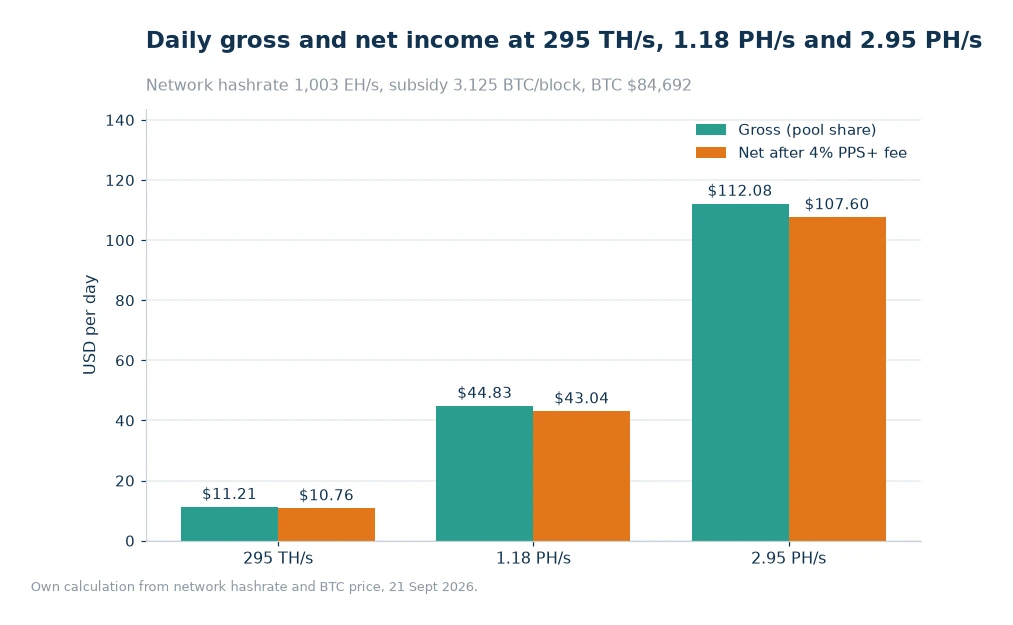
Mining arithmetic is linear, and that is both its comfort and its trap. At 295 TH/s the pool credits 0.00013234 BTC a day, $11.21 at $84,692 per BTC and $10.76 after the listed 4% on the block-reward component. Ten times the hashrate gives exactly ten times the credit, $112.08 gross, but it does not give ten times the convenience or ten times the attention per machine.
Key takeaways
- 295 TH/s credits 0.00013234 BTC a day, $11.21 gross and $10.76 after the listed 4% on the block-reward component.
- 1.18 PH/s is four racks of that size and credits $43.04 net a day; 2.95 PH/s is ten and credits $107.60.
- Credit, energy and cooling scale in proportion; network links, monitoring and rent arrive in steps.
- A monthly plan built on $322.80 of net credit per rack has to absorb downtime and difficulty drift.
One rack as a unit of account
Pick a hashrate and treat it as a unit. At 295 TH/s the daily output is 0.00013234 BTC, which is a share of the 450 BTC issued each day at a network hashrate near 1,003 EH/s. The share is small, the arithmetic is short, and the result can be multiplied by the number of racks without any adjustment for scale, because the pool pays per share rather than per site.
That property is genuinely useful. It means a business plan can be written at one rack and extended to ten, and it means a single rack's statement is a valid sample for the whole fleet as long as the machines are of the same model and the difficulty has not moved. It also means that a fleet's output is a poor place to look for problems: a machine running at 80% of its hashrate disappears inside a total that is otherwise healthy.
What multiplies and what arrives in steps
Credit multiplies. Energy multiplies, and so does the heat that has to be removed, which is why a hall of ten racks needs cooling sized for ten rather than for one plus a margin. The physical plant grows in proportion, and the electricity bill grows with it, so the margin per rack stays where it was in the single-rack calculation unless the tariff or the machine changes.
The rest arrives in steps. A network link serves a rack or a hall for the same monthly price. A monitoring habit that checks one dashboard per day checks a fleet in the same time, provided the dashboard aggregates. Space, insurance, spares and the person who swaps a fan are step costs: they jump when the operation crosses a threshold and then stay flat for a while. Those steps are where a fleet finds its advantage, and they are also where a small operation discovers that its cost per terahash is higher than the table suggested.
The account stays one account
Scaling up does not require a second relationship with the pool. A ViaBTC Crypto Mining account can carry many workers under one login, and the payout address, the payout method and the fee terms are set once rather than per machine. That is a small administrative detail with a large operational consequence: a fleet can be audited from one statement, and a discrepancy between the sum of the workers and the total credit is visible immediately.
It also keeps the payout method decision in one place. PPS+ settles hourly against current difficulty with a listed 4% on the block-reward component and a listed 2% on the transaction-fee component; PPLNS pools both components under a listed 2% and settles after 6 confirmations across the last 5 difficulty rounds. At fleet scale the timing difference is worth more in absolute terms, because a day of delayed settlement is ten times larger than it was at one rack, even though the percentage is identical.
Three sizes, one rate
The table keeps the machine at the same efficiency and the tariff out of the calculation, so the columns move only with hashrate. The last column multiplies the net figure by 30, which is the number a monthly budget actually needs.
| Scale | BTC per day | Gross USD | Net USD | Net over 30 days |
|---|---|---|---|---|
| 295 TH/s | 0.00013234 | $11.21 | $10.76 | $322.80 |
| 1.18 PH/s | 0.00052936 | $44.83 | $43.04 | $1,291.20 |
| 2.95 PH/s | 0.00132339 | $112.08 | $107.60 | $3,228.00 |
The monthly column is the one to hold against a lease, a power contract or a loan payment, because those arrive monthly while the credit arrives hourly. A fleet that clears its monthly obligations by 20% on paper has very little room once a week of downtime and a difficulty adjustment are added, and the table makes that thinness visible before the commitment rather than after it.
Worked example
Build the fleet from a single rack of 295 TH/s and check that every column scales together.
- Per terahash: 450 BTC a day divided by 1,003,107,267,295 GH/s is 0.00000044861 BTC.
- One rack: 295 multiplied by 0.00000044861 is 0.00013234 BTC, or $11.21 at $84,692.
- Listed 4%: 0.00013234 multiplied by 0.96 is 0.00012705 BTC, or $10.76 a day.
- Four racks: 4 multiplied by 0.00013234 is 0.00052936 BTC, and 4 multiplied by $10.76 is $43.04.
- Ten racks: 10 multiplied by 0.00013234 is 0.00132339 BTC, and 10 multiplied by $10.76 is $107.60.
- Month: 30 multiplied by $10.76 is $322.80, and 30 multiplied by $107.60 is $3,228.00.
- Energy check at 26 J/TH: 295 multiplied by 26 is 7,670 W, or 184 kWh a day per rack and 1,840 kWh for ten.
- If the tariff is $0.05, one rack pays $9.20 for power and keeps $1.56 of its $10.76 credit.
Cash flow at fleet scale
Ten racks turn a daily trickle into a monthly sum worth planning around, which changes what to do with the coins. Some operators keep the balance in BTC and pay costs from other funds; others convert enough to cover the power bill each week and leave the rest. The multi-currency wallet keeps the mined coins and the payment for the bill in one account, and Auto Conversion can turn a chosen part of each payout into the currency a supplier wants without a separate exchange trip.
The habit that matters at this scale is reconciliation. Compare the sum of the workers with the daily credit, compare the credit with the plan, and compare the plan with the invoice. Three comparisons, once a day or once a week, catch almost everything: a dead machine, a firmware change that lowered hashrate, a tariff step, or a payout that arrived late. The ViaBTC App covers the first two from a phone, which is usually where the fleet owner is when something goes wrong.
Frequently asked questions
Does a bigger operation earn more per terahash?
No. At 295 TH/s the net credit is $10.76 a day and at 2.95 PH/s it is $107.60, exactly ten times, because the pool pays per share; any advantage comes from fixed costs spread over more machines.
How much does one 295 TH/s rack earn in a month?
About 0.00381150 BTC, or $322.80 at $84,692, after the listed 4% on the block-reward component and before power, cooling and site costs.
What is the main risk when adding racks?
Fixed costs and cooling arrive in steps while credit scales in a straight line, so a fleet can look profitable per rack on paper and still lose money once the site costs and downtime are counted.
Scale the plan, not just the order
Multiply the rack figure by the number of racks, then subtract the step costs as whole items rather than percentages. If the result still clears the monthly bill with room for a bad week, the fleet is soundly sized. The Profit Calculator on the ViaBTC site will rebuild the credit column at current difficulty, and the power contract supplies the rest, which is the half that does not scale for free.
Sources: the ViaBTC homepage for pool setup and payout terms and the fee page for the listed 4% and 2% rates[1]. Chain inputs read 21 Sept 2026: network hashrate 1,003 EH/s, difficulty 132.76 T, subsidy 3.125 BTC per block, 144 blocks a day, BTC $84,692. Published 22 Oct 2026. Figures assume continuous uptime; energy examples use the stated efficiency and tariff.